About Me
Mission
Values
My work is guided by three principles:
Scientific rigor – recommendations grounded in sound ecological science.
Integrity – objective advice that clients can trust.
Quality – thorough, practical work delivered professionally and on schedule.
I am an experienced terrestrial ecologist living in the traditional territory of the Ktunaxa and Secwépemc people. I have a passion for nature, conservation, Indigenous reconciliation, and science. I enjoy the complexity of ecosystems and the challenges in understanding each unique system. I get immense satisfaction and joy from helping clients understand ecosystems better and find practical, science based solutions to mitigate disturbance or restore ecosystems.
Meghan, MSc, RPBio
Examples of Past Projects
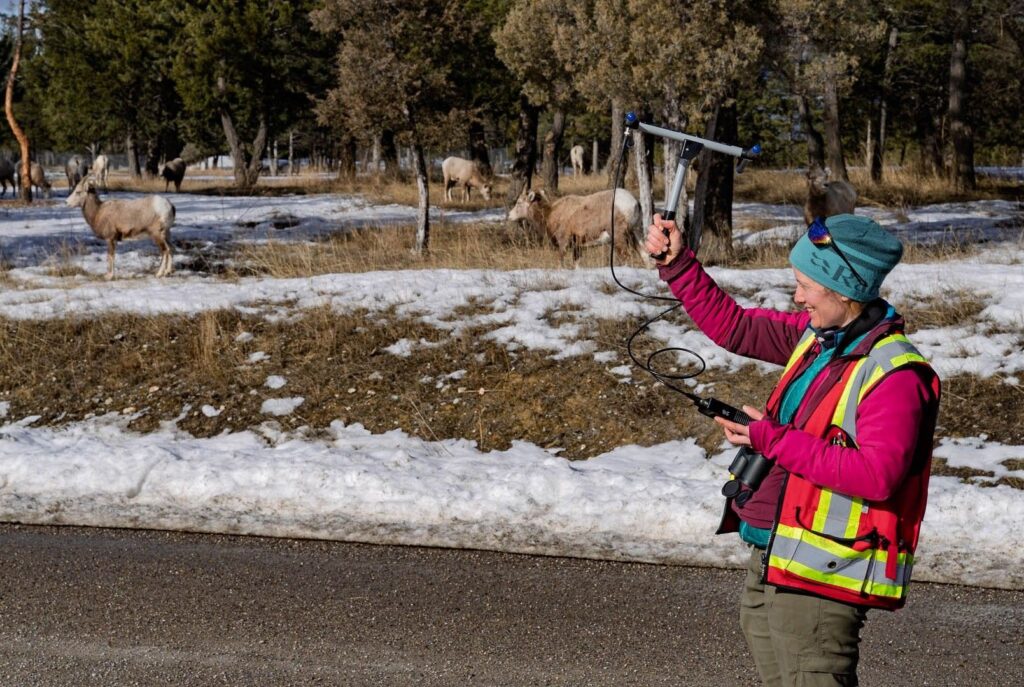
- Monitoring the effectiveness of the Radium wildlife overpass for the Shuswap Band. Project included collaring 29 bighorn sheep to monitor movement and habitat use. I also used wildlife cameras to monitor wildlife use of the overpass and fence ends.
- Monitoring of escape routes on the Radium wildlife overpass for BC MoTT. Project used wildlife cameras to monitor if wildlife successfully used escape routes (jump outs and one-way gates), turned around, or breached the escape route.
- Assessment of culverts along Highway 93/95 South for passage by American badgers. Project surveyed if culverts could provide a safe passage for badgers and if not, what mitigation actions were necessary. Project for the Shuswap Band.
- Indigenous Led Chronic Wasting Disease (CWD) Surveillance. Project established a program to test for CWD in First Nation harvested cervids and provided workshops or presentations to other First Nations to increase awareness of CWD and testing methods.
- Species at Risk Surveys on the Shuswap Band Reserve. Project surveyed for and mapped habitat for American badgers, flammulated owls, little-brown myotis, and painted turtle in the first year. In the second year I implemented habitat protection and enhancement measures for species at risk on the Reserve.
- Estimating density of elk from camera trap data with the Bayesian Spatial Count model for the Shuswap Band.
- Wildlife monitoring at the Quintette Mine. I designed and implemented a camera trap project to monitor wildlife density and occurrence at the mine during construction and operation.
- Baseline vegetation surveys and invasive species monitoring for the Murray River Coal Project.
- Planning and coordination of baseline wildlife surveys for the Rocky Creek Coal Project.
- Survey and habitat assessment for species at risk at the Richmond Training Area for the Department of National Defence. I managed the project, completed habitat surveys, habitat mapping, coordinated surveys, and helped author the final report.
- Portage Mountain Bat Monitoring for BC Hydro. I analyzed bat acoustic data to identify species present, relative use, presence of bats during hibernation, and assess for impacts of blasting on bat activity.
Publications
Anderson, M., B. N. McLellan, and R. Serrouya. 2017. Moose response to high-elevation forestry: Implications for apparent competition with endangered caribou. Journal of Wildlife Management 82: 299-309. Link
Pigeon, K.E., M. Anderson, D. MacNearney, J. Cranston, G., Stenhouse, and L. Finnegan. 2016. Towards the Restoration of Caribou Habitat: Understanding Factors Associated with Human Motorized Use of Legacy Seismic Lines. Environmental Management 58:821-832. Link
Anderson, M. 2014. The Role of Human Altered Landscapes and Predators in the Spatial Overlap Between Moose, Wolves, and Endangered Caribou. University of Alberta M.Sc. thesis. Link
Anderson, M. 2009. Evaluation of bioindicators and structural attributes as indicators of old- growth forests. University of British Columbia undergraduate thesis.
Conference Presentations & Talks
Anderson, M. 2025. Why did the Badger Cross the Road? Effective and Simple Ways to Mitigate Roadway Mortality. Wings Over the Rockies Festival, Invermere, BC.
Anderson, M. 2024. Chronic Wasting Disease. Presentation for the Windermere Rod and Gun Club, Invermere, BC.
Anderson, M. and M. Jalkotzy. 2019. On the Path to Improving Habitat Connectivity Calculations: Combining Both Movement and Habitat Selection. Alberta Society of Professional Biologist Conference. Lake Louise, Alberta.
Anderson, M. Managing Ungulate Populations. Columbia Regional Ecological Discussions (CRED Talks) December 2017. Columbia Mountains Institute, Revelstoke, BC.
Anderson, M., B. McLellan, and R. Serrouya. Managing Moose for Mountain Caribou Conservation. March 2015. Alberta Chapter of the Wildlife Society Conference, Edmonton, AB.
McNay, R., G.D. Sutherland, M.S. Anderson, V. Brumovsky, L. Giguere, M. Dickie, M. Cody. 2016. Understanding the functional components of predator-prey response to habitat restoration: A Bayesian approach. PeerJ Preprints.